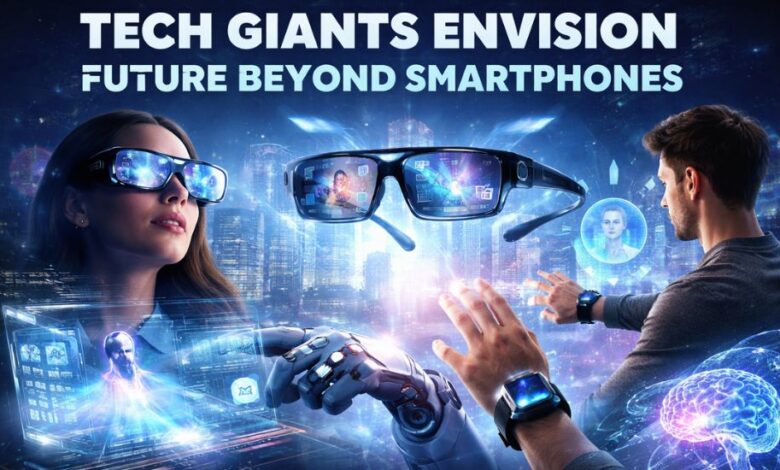
For more than a decade, the smartphone has been the center of modern digital life. It replaced cameras, maps, music players, wallets, and even personal computers for many everyday tasks. But as smartphone innovation slows and global markets approach saturation, the world’s largest technology companies are quietly preparing for what comes next. Today, tech giants envision a future beyond smartphones, one where computing becomes more immersive, ambient, and seamlessly woven into daily life.
This shift does not mean smartphones will disappear overnight. Instead, industry leaders are working toward a gradual transition where phones become secondary devices, replaced or complemented by wearables, artificial intelligence, extended reality, and even brain-computer interfaces. The post-smartphone era is shaping up to be one of the most transformative periods in the history of technology.
The Limits of the Smartphone Era
Smartphones are still powerful, but their evolution has slowed. Yearly upgrades now focus on incremental improvements: slightly better cameras, marginally faster processors, or refined designs. For tech giants that depend on growth and innovation, this plateau presents a challenge.
Several factors are driving the search for alternatives:
- Market saturation: Most people who want a smartphone already own one.
- Longer upgrade cycles: Consumers keep phones for three to five years instead of upgrading annually.
- Design constraints: Flat touchscreens limit how users interact with digital content.
- Rising competition: Hardware margins are shrinking as devices become commoditized.
To move forward, companies must reimagine how humans interact with technology—beyond tapping on glass screens.
A Shift Toward Ambient and Invisible Computing
One of the core ideas behind the post-smartphone vision is ambient computing. Instead of actively pulling out a device, technology fades into the background and responds naturally to voice, gestures, location, and context.
Artificial intelligence plays a central role here. AI systems are becoming proactive rather than reactive, anticipating user needs instead of waiting for commands. In this future, information appears when and where it’s needed—through smart glasses, voice assistants, or subtle visual cues—without constant screen time.
This vision reduces digital friction and makes technology feel more human, intuitive, and less intrusive.
Apple’s Vision: Spatial Computing and Wearables
Apple has long been known for redefining product categories rather than inventing them first. Its vision beyond smartphones revolves around spatial computing, wearables, and tightly integrated ecosystems.
With the introduction of mixed-reality headsets and continued investment in augmented reality, Apple is laying the groundwork for a future where digital information exists in physical space. Smart glasses, still under development, are expected to overlay navigation, messages, and contextual data directly into the user’s field of view.
Meanwhile, devices like the Apple Watch already demonstrate how functionality once tied to smartphones—health tracking, payments, notifications—can live on the body instead. Over time, Apple envisions the phone becoming more of a hub than a primary interface.
Google’s Approach: AI-First and Platform-Driven
Google is betting heavily on artificial intelligence as the gateway beyond smartphones. Rather than focusing solely on new hardware, Google emphasizes platforms, ecosystems, and services powered by AI.
Its investments in augmented reality, Android XR, and ambient assistants point to a future where computing happens across multiple surfaces—smart glasses, cars, homes, and public spaces. Google’s vision centers on context-aware AI, capable of understanding what users need based on time, location, and behavior.
In this model, smartphones still exist, but they act more like controllers or backup screens rather than the primary point of interaction.
Meta’s Bet on Immersive Reality
Meta has been the most vocal about replacing smartphones entirely. The company believes immersive technologies—virtual reality and augmented reality—will define the next major computing platform.
Through smart glasses, social VR environments, and mixed-reality headsets, Meta envisions digital experiences that feel physical and shared. Instead of scrolling through feeds, users may one day walk through virtual spaces, attend meetings as holograms, or interact with digital objects placed in the real world.
For Meta, the post-smartphone future is deeply social, immersive, and embodied.
Microsoft and the Enterprise-Driven Future
Microsoft approaches the post-smartphone era from a productivity and enterprise angle. Its focus is less on replacing phones for consumers and more on redefining how professionals work.
Mixed-reality tools, cloud computing, and AI copilots are central to Microsoft’s strategy. In workplaces, smartphones may be replaced by smart headsets, voice-controlled assistants, and spatial interfaces that allow employees to visualize data in three dimensions.
This enterprise-first approach often lays the groundwork for broader consumer adoption later on.
The Rise of Wearables as Primary Devices
Wearables are no longer just accessories. Smartwatches, rings, earbuds, and health sensors are increasingly capable of handling tasks once reserved for smartphones.
Key advantages of wearables include:
- Always available: No need to pull out a device.
- Health integration: Continuous monitoring of heart rate, sleep, movement, and stress.
- Subtle interaction: Glances, taps, or voice commands replace prolonged screen use.
- Ecosystem connectivity: Wearables act as nodes in a larger digital network.
As these devices become more powerful and autonomous, they reduce reliance on smartphones and pave the way for hands-free computing.
Extended Reality: Screens Without Screens
Augmented reality (AR), virtual reality (VR), and mixed reality (XR) are often described as the natural successors to smartphones. Instead of shrinking screens further, tech giants are effectively making screens infinite.
AR glasses can project directions onto streets, translate signs in real time, or display messages without blocking the real world. VR environments offer fully immersive spaces for work, education, and entertainment.
While current hardware still faces challenges—battery life, comfort, and cost—rapid improvements suggest XR will play a major role in the post-smartphone ecosystem.
Brain-Computer Interfaces: The Long-Term Frontier
Perhaps the most radical vision beyond smartphones comes from brain-computer interfaces (BCIs). Companies like Neuralink are exploring ways for humans to interact with computers using neural signals.
Although still experimental, BCIs could one day allow users to send messages, control devices, or access information using thought alone. This would represent the ultimate hands-free, screen-free interface.
While widespread adoption remains many years away, BCIs highlight how far beyond smartphones future computing may go.
Challenges on the Road Beyond Smartphones
Despite bold visions, significant challenges remain:
- User adoption: New form factors must feel natural and socially acceptable.
- Privacy concerns: Always-on sensors and AI raise serious data protection issues.
- Battery and hardware limits: Smaller devices must deliver powerful performance.
- Cost barriers: Advanced wearables and XR devices remain expensive.
- Regulation and ethics: Governments and societies must adapt to new realities.
Overcoming these obstacles will determine how quickly the post-smartphone future arrives.
Will Smartphones Really Disappear?
Most experts agree that smartphones won’t vanish suddenly. Instead, they will gradually fade into the background, becoming secondary or supporting devices. Much like laptops didn’t disappear after smartphones arrived, phones will coexist with newer technologies for years.
The real transformation lies in how we interact with technology—not whether a single device survives.
The Bigger Picture: A More Human Digital Experience
As tech giants envision a future beyond smartphones, the ultimate goal is not novelty but usability. The next era of computing aims to reduce friction, limit distraction, and integrate seamlessly into human life.
Instead of staring down at screens, users may look up, engage with their surroundings, and interact with digital information more naturally. Technology becomes less about devices and more about experiences.
Final Thoughts
The smartphone revolution defined the early 21st century, but it is no longer the final destination. As artificial intelligence, wearables, extended reality, and ambient computing mature, tech giants are steadily building a future where smartphones are no longer the center of our digital universe.
This transition will take time, experimentation, and adaptation, but its direction is clear. The post-smartphone era promises a world where technology feels more intuitive, immersive, and human-centric.
At newsz, we closely follow how these transformations shape society, innovation, and everyday life. As the next generation of computing unfolds, understanding this shift will be essential—not just for tech enthusiasts, but for everyone living in an increasingly connected world.